The S&C Profession Deserves More Than a Multiple-Choice Exam: Challenging Legacy Dogma
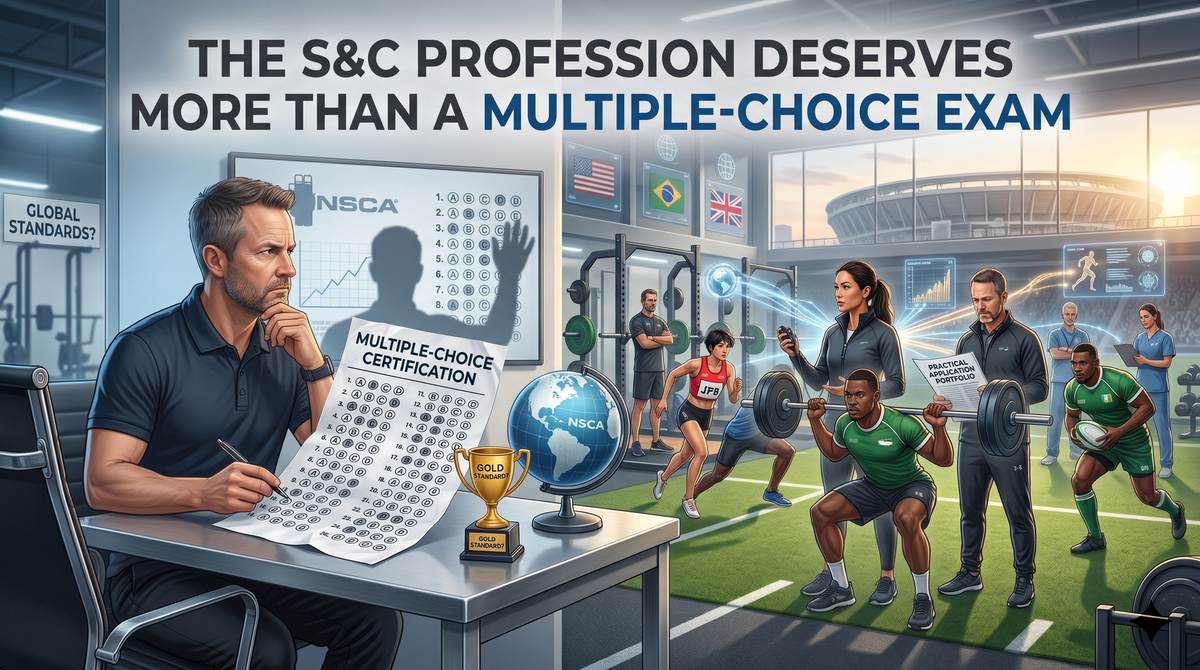
For decades, the Strength and Conditioning community has been dominated by a singular narrative. The NSCA has aggressively positioned itself not only as the gold standard of certification but as the de facto global authority. They promote their foundational credential as the ultimate validation of competence, a requirement for elite-level employment worldwide. And how do they measure this supposed gold standard? They use a multiple-choice examination.
It is absolutely no wonder that our profession, which we should be defining as an applied sport science, is often not taken seriously. It is not respected in the same way that allied health fields like physiotherapy or athletic training are. This systemic reliance on rote memorization and fact-recall erodes the very foundations of high-performance coaching. S&C is not a trivia contest; it is a complex, applied discipline that requires far more than knowing facts that can be bubbled in on a Scantron sheet.
Theory vs. Real-World Complexity
Let’s be clear about what high-level coaching actually demands. It is an environment of profound uncertainty. S&C practitioners do not execute sterile laboratory procedures; they interact with conscious biological and psychological entities. You must be able to visually diagnose movement deficiencies on a chaotic weight room floor, delivering instantaneous, precise communication. A true professional synthesizes biomechanics, physiology, and nutrition to build a cohesive, personalized adaptation plan in real-time. A multiple-choice exam can only tell you if a candidate can identify the theoretical solution from a preset list of distractors. It cannot tell you if they can actually coach.
Applied Professions Demand Practical Assessments
If we wish to elevate S&C to a respected scientific profession, we must observe how other high-stakes applied fields manage licensing. Medical students must complete rigorous practical clinical examinations where they diagnose standardized patients. Physiotherapists require extensive clinical hours and mandatory practical assessments of their physical therapy interventions. Even skilled trades require extended apprenticeships and portfolios of applied work. Yet, the NSCA expects the industry to accept a standard that is decades out of date.
The Global Export of Mediocrity
I am not based in the United States, so historically, I wasn't too bothered by what I viewed as a domestic American standard for domestic American coaches. However, the USA is seen globally as a leader in sports performance, and this dynamic has a massive knock-on effect that is now becoming dangerous. The NSCA is no longer content to define standards for their home market. They are actively positioning themselves as a global organization, seeking to build a worldwide monopoly based purely on this poor standard of multiple-choice assessment.
This is what we, as an international coaching community, must push back against. Other legitimate, accredited S&C organizations worldwide must push back heavily on this attempted monopoly and its exported, inadequate standard of assessment. The evolution of S&C demands academic rigor and undeniable practical mastery. We deserve a standard that reflects that. Let’s make it happen.