What is Strength and Conditioning (S&C)
Look, if you ask ten people "What is Strength and Conditioning," nine of them will probably say something about lifting heavy weights and yelling "one more rep." And honestly, that meathead stereotype is our own fault. For decades, the public face of S&C has been some massive human in a cut-off t-shirt beasting people until they puke.
If that’s what you think S&C is, you’re missing the entire point.
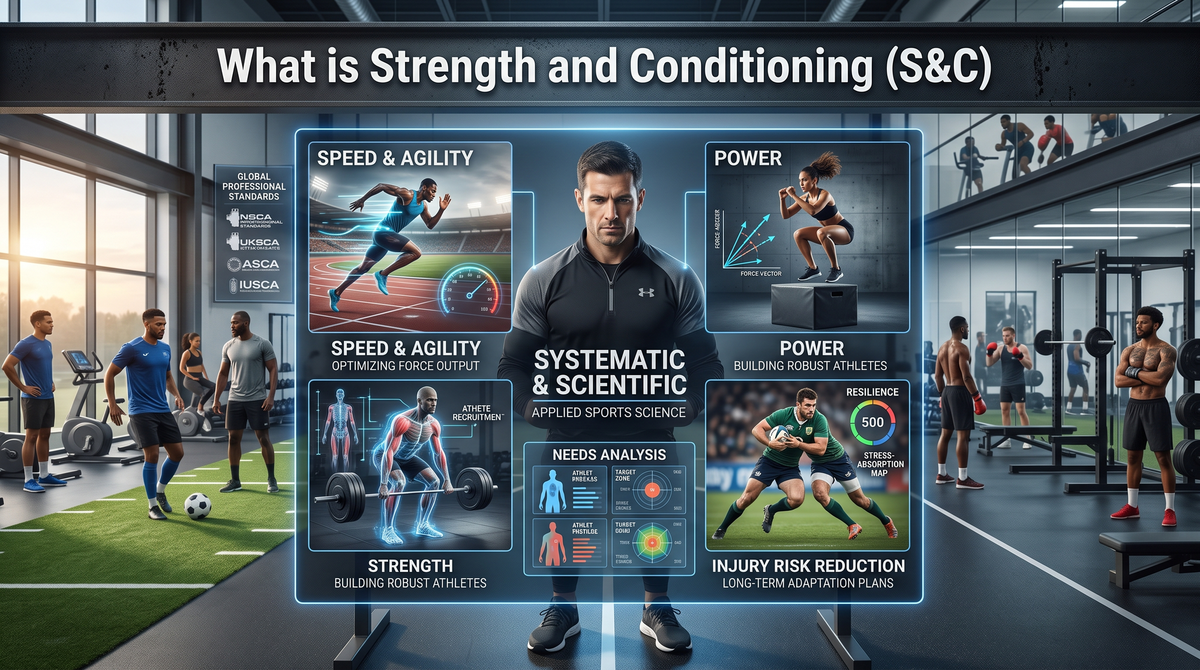
Let’s get real about what we actually do. At its absolute core, Strength and Conditioning is the systematic, scientific physical preparation of an athlete for sports performance.
The key word there is preparation. We are not there to entertain them. We are not there to make them "tired." We are there to use strategic, physical stress to force specific physiological adaptations that translate directly to winning. Period.
But here is my unfiltered take: too many coaches treat S&C like a random trade instead of a rigorous scientific profession. They focus entirely on fatigue. They measure success by how sweaty the athletes are. Guess what? Fatigue is easy to generate. Adaptation—true, performance-enhancing change—that’s the hard part.
The Real Pillars of S&C
When done properly, S&C is Sports Science in applied action. It’s about strategically manipulating variables to improve specific qualities:
Strength: The ability to generate force.
Power: The ability to generate force quickly (explosiveness).
Speed & Agility: Moving rapidly and changing direction effectively.
Endurance: The aerobic and anaerobic capacity to maintain performance.
Hypertrophy: Building functionally useful muscle mass.
But the most critical pillar—the one that too many coaches ignore until it’s too late—is Injury Risk Reduction. If your athlete is stronger, more robust, and can absorb force better, they stay on the field. A broken athlete coaches zero percent. S&C is often the only thing standing between a career-ending injury and a championship ring.
A true S&C program isn’t a collection of "cool exercises I saw on Instagram." It is a coherent, long-term plan based on a thorough needs analysis: what does this specific athlete, in this specific position, playing this specific sport, actually need to get better? You don't train a marathon runner like a lineman. It sounds obvious, but you’d be surprised how often that basic logic gets ignored for methodological dogma.
Professionalization is the Goal
This systemic approach is what separates a true professional from someone just running a bootcamp. And this demands standards.
For years, established regional organizations have defined these standards. The NSCA (USA) with the CSCS, the UKSCA (UK) with the ASCC, and the ASCA (Australia) have tried to codify what a competent coach looks like within their territories. While their histories and methods differ, they paved the way.
More recently, organizations like the IUSCA (International Universities Strength and Conditioning Association) have pushed for a unified, global standard—emphasizing a combination of degree-level knowledge and mandatory practical coaching assessment. They represent the modern evolution of the field: moving away from inherited regional brand names toward comprehensive, practical international competency.
But no organization can save you if you don't use your brain. S&C is about being a critical thinker first, and a motivator second. It’s about movement diagnostics, strategic periodization, and understanding human biology.
It is, and should never be, just "beasting" your athletes. Let’s raise the standard.