Degree vs. Certificate: What Baseline Does the Profession Actually Demand?
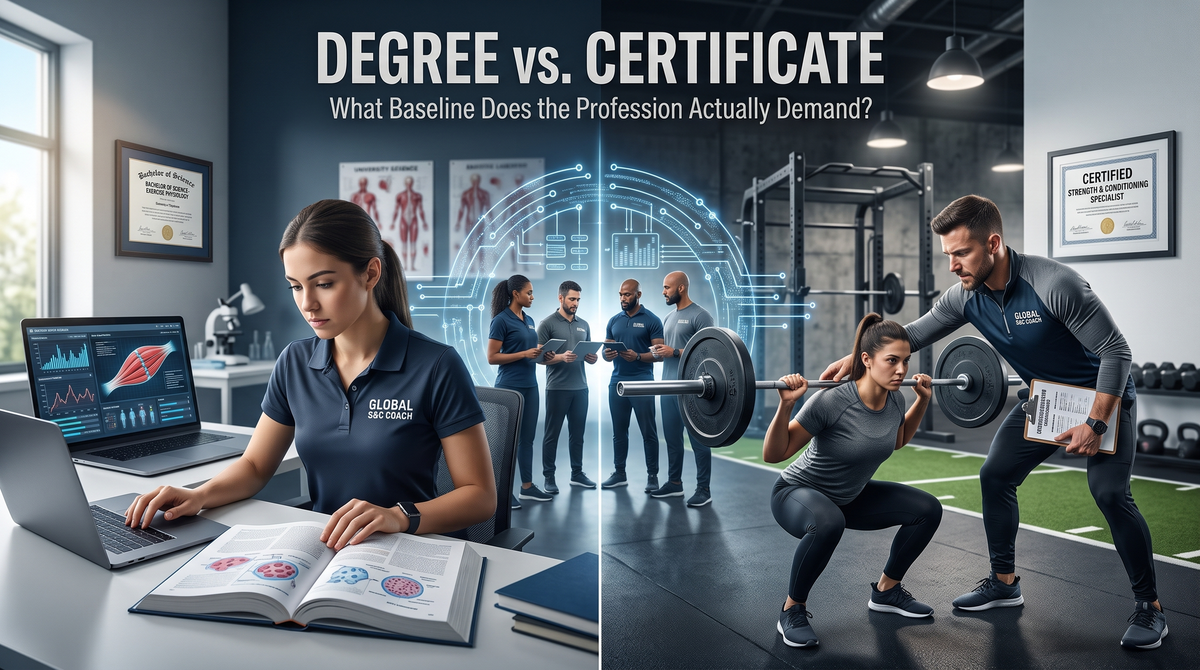
A persistent and cyclical debate plagues the global Strength and Conditioning profession: does a practitioner require a multi-year university degree to coach effectively, or is a targeted vocational certificate sufficient? This argument is fundamentally flawed. It presents a false dichotomy that misunderstands the nature of high-level coaching. If we wish to elevate this field from a mere trade to a respected scientific profession, we must scrutinize the actual utility of both pathways and identify where the true optimal baseline lies.
The Illusion of the Generic Degree
The traditional prerequisite for elite coaching roles has increasingly become a university degree in exercise science, kinesiology, or a related field. Proponents rightly argue that such programs establish a vital foundation in anatomy, biomechanics, and physiology. A rigorous academic background allows a coach to understand the underlying mechanisms of human movement and adaptation.
However, we must be intellectually honest about the limitations of a purely academic credential. A university degree inherently prioritizes theoretical knowledge over practical application. Students can spend three or four years mastering physiological pathways and passing written examinations, yet graduate entirely incapable of effectively cueing a complex lift on a busy weight room floor. We have conflated academic literacy with coaching competency. The possession of a bachelor's degree simply proves that an individual can navigate an academic institution; it does not automatically prove they can coach.
The Shortfall of the Isolated Certificate
Conversely, the vocational certification pathway is frequently championed for its practical focus and speed of entry. Certificates are designed to validate specific and actionable skills.
Yet, relying solely on isolated certificates is equally problematic. The reality of many fast-tracked certificates is troubling:
- Lack of Depth: They often lack the rigorous scientific underpinning necessary for a high-level practitioner to adapt when initial protocols fail.
- Variable Quality: Some certifications can be acquired quickly and affordably.
- Theoretical Bias: In many cases, standard credentials rely entirely on multiple-choice examinations without any prerequisite for practical assessment.
If our profession relies entirely on short courses, we risk producing technicians rather than true scientists of human performance.
Rejecting the Dichotomy
The debate itself is the problem. We should not be asking whether a degree is superior to a certificate, nor should we accept that a coach must complete them as separate endeavors. The profession actually demands a synthesis of both.
The optimal pathway to becoming a highly effective Strength and Conditioning coach requires a degree in a relevant field to provide a strong theoretical foundation, coupled with vocational certifications to validate practical skills.
The Embedded Solution: A New Standard
The most logical evolution for the profession is the integration of vocational qualifications directly into university degree programs. The modern, progressive framework demands a holistic approach:
- Integrated Qualifications: Academic institutions must fully embed professional practitioner certifications into their curricula, ensuring students graduate with both a degree and industry-recognized credentials.
- Mandatory Practical Experience: Degrees should require extensive hands-on training, such as supervised placements, to build real-world confidence.
- Holistic Competency: The focus must shift to developing well-rounded professionals who possess technical expertise alongside communication and leadership skills.
In this model, the gap between theory and practice is eliminated. By fully embedding professional certifications into academic degrees, we ensure that an individual entering the workforce possesses a mind trained in scientific inquiry and a body capable of elite physical instruction.
If we wish to define a truly international standard for Strength and Conditioning, we must abandon outdated arguments. We must demand academic rigor. We must demand practical mastery. Most importantly, we must demand educational frameworks that refuse to separate the two.