The Global S&C Landscape: A Critical Review of Major Organizations
This article presents a necessary dialogue regarding the global landscape of Strength and Conditioning (S&C) organisations. My intention here is to provide an independent, critical perspective, having taken time to go through each of the certification processes, and understanding the pros and cons of each organisation.
Furthermore, my goal is to enhance the S&C profession, which as time goes by, becomes ever more necessary to define internationally, rather than regionally. Such discussions are vital if we are to frankly evaluate where these organizations originate, what they truly offer, and where they are, ostensibly, failing the very professionals they are meant to serve.
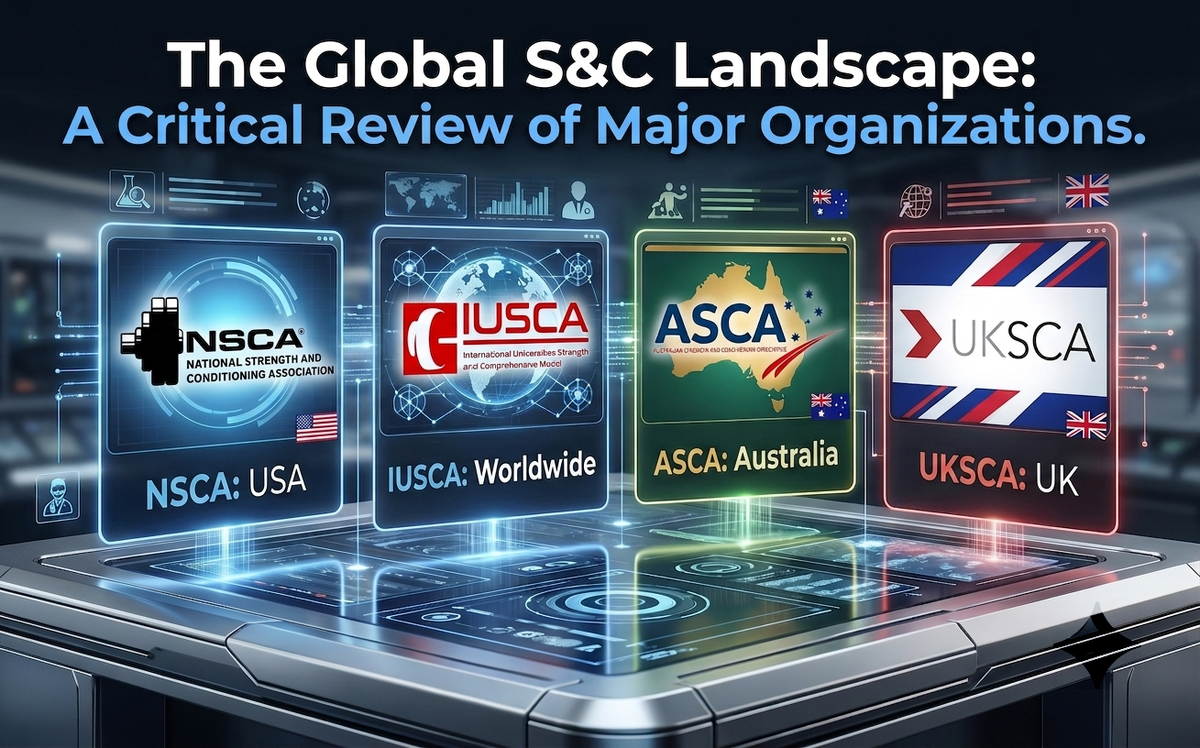
We shall examine four principal entities that command significant influence on global practice, in the following order: the NSCA, IUSCA, ASCA, and UKSCA.
1. NSCA (National Strength and Conditioning Association)
The National Strength and Conditioning Association (NSCA) is an international non-profit educational and charitable organization dedicated to advancing the strength and conditioning and related sport science professions. Originating and headquartered in the United States, the NSCA’s primary functions include providing research-based educational resources, facilitating professional development through conferences and publications, and administering several widely recognized professional certifications, most notably the Certified Strength and Conditioning Specialist (CSCS). The NSCA community, which includes both individual members and certified professionals, is estimated to exceed 60,000 people.
2. IUSCA (International Universities Strength and Conditioning Association)
The International Universities Strength and Conditioning Association (IUSCA) is a worldwide non-profit organization and collaborative network founded to raise standards in strength and conditioning education and applied practice. It does not operate from a single domestic headquarters but rather acts as a global collaborative of over 150 universities and institutions. The IUSCA provides an independent, internationally validated framework (IQF Levels 1-8), offers an international university degree program accreditation, and offers vocational qualifications through its International Qualifications Framework (IQF). Its work aims to bridge the gap between academic theory and practical coaching competence while facilitating barrier-free knowledge sharing through its Diamond Open Access academic journal. It's key professional level certification is the IUSCA IQF Level 6 Accredited International Strength and conditioning Practitioner (aISCP) designation. Current membership is estimated at over 50,000 S&C coaches worldwide.
3. ASCA (Australian Strength and Conditioning Association)
The Australian Strength and Conditioning Association (ASCA) is the peak professional body for strength and conditioning coaches in Australia. Its mission is to bridge the gap between sports science and practical application by providing high-quality coach education and maintaining accredited standards. The ASCA conducts multi-level professional development courses that are recognized through Australia's National Coach Accreditation Scheme and publishes its own peer-reviewed research publication, the Journal of Australian Strength and Conditioning. The association represents and supports a growing base of over 6,000 accredited coaches coaching athletes at all levels of sport.
4. UKSCA (UK Strength and Conditioning Association)
The United Kingdom Strength and Conditioning Association (UKSCA) is a professional body for strength and conditioning coaches in the United Kingdom. Launched with the idea of promoting the S&C profession in a similar format to the NSCA, the UKSCA seeks to establish and maintain high professional standards for practitioners and facilities. Its core functions involve promoting the dissemination of good practice and research, facilitating communication within the S&C community, and administering the rigorous, weightlifting focussed, Accredited S&C Coach (ASCC) standard. The association currently represents a membership of over 2,600 individuals, including accredited coaches and those progressing towards professional recognition.
Now that we have an understanding of the current landscape, let's proceed with some critical analysis.
The Problem of Standardisation Without Rigor: NSCA (USA)
The National Strength and Conditioning Association (NSCA), originating in the United States, holds the mantle of being the oldest and arguably the most globally recognized entity in our field. For many decades, possession of their Certified Strength and Conditioning Specialist (CSCS) qualification has been perceived as the essential minimum requirement for serious coaching roles. However, a high-profile reputation must not be confused with rigorous professional validation.
The principal criticism of the NSCA is a major one if we truly want to progress as a serious profession: its certification process. The CSCS qualification is awarded solely upon passing a multiple-choice examination. This is a tough, theoretical challenge, certainly, yet the complete absence of any mandatory practical coaching assessment represents a glaring flaw. In my estimation, achieving a passing score on a multiple-choice test cannot meaningfully translate to high-level, real-world coaching competency. Furthermore, it is debatable whether such a limited model should even be considered valid for high-level S&C practice anywhere, including within the US, without a rigorous, compulsory practical component.
The Rise of a Progressive, Collaborative Model: IUSCA (Worldwide)
In contrast to this siloed approach, the International Universities Strength and Conditioning Association (IUSCA), a worldwide entity, has emerged as a formidable global player by addressing the critical gap between academic theory and practical application. While younger than its counterparts, IUSCA has secured remarkable worldwide enrolment, attracting elite institutions such as MIT, Yale, and UCLA in the US, alongside Leeds Beckett in the UK. They are now partnered with over 150 universities globally.
The IUSCA certification pathway appears to be the most comprehensive assessment model currently operating. Their top-tier qualification demands a university degree, a thorough practical coaching assessment, ongoing portfolio development, and a minimum of two years of professional experience. This multi-layered structure systematically tackles the theory-practice divide that others ignore.
Isolation and Promise: ASCA (Australia)
The Australian Strength and Conditioning Association (ASCA) represents an established and respected entity, but its influence is primarily contained within Australia. While their certification pathway is solid, requiring academic knowledge, practical assessment, and experience, the ASCA suffers from limited international visibility. Outside of the specific Australian sporting landscape, the qualification remains relatively obscure. It has not yet managed to export its valuable education effectively on a truly global scale.
Stagnation by Design: UKSCA (UK)
The United Kingdom Strength and Conditioning Association (UKSCA), representing the UK, presents a different and more cautionary trajectory. A major influence on professional S&C practice in the UK 10–20 years ago, it was once considered a pioneer with its robust practical assessment model. However, its popularity has dwindled recently, largely because it has failed to evolve with the times. A principal area where applicants frequently fail is the Olympic Weightlifting component. UKSCA demands mastery of the full lifts according to their highly specific and complex technical model. This unwavering adherence is problematic because masterful execution of full Olympic lifts is arguably not necessary or appropriate for coaches working across all sporting domains. By failing to adapt this requirement, UKSCA has isolated itself while the broader industry modernizes.
The Future of Global Development
A wider consideration, beyond mere certification, is the role these organizations play as major distributors of scientific knowledge. For years, subscriber-based journals have dominated the field. And while the NSCA currently publishes the most research, it is here that the IUSCA has introduced significant and welcome disruption. Their academic journal utilizes a Diamond Open Access model, meaning it is entirely free for both readers and authors. This eliminates financial barriers to both publishing research and accessing it. Compared to traditional subscriber or author-pays models, this represents a massive, necessary step forward for the global, barrier-free dissemination of S&C science.
Looking to the future, the primary focus must be on global development. How these organizations choose to engage with a multipolar S&C world will define their longevity. The NSCA, despite its seniority, appears locked into a retrograde top-down model. Their strategy seems primarily focused on exporting the CSCS globally as the sole legitimate credential, effectively imposing a US-centric authority. This aggressive marketing of a static credential, particularly one devoid of a practical component, goes against the very spirit of scientific inquiry and the necessity of adaptive professional growth.
The IUSCA, in stark contrast, is actively rolling out the International Qualification Framework (IQF), which boasts validity in over 120 countries worldwide. This framework does not seek to export a single certificate; rather, it aims to harmonize standards globally while respecting local educational pathways. This collaborative approach represents, without question, the best future option to watch for a truly unified and globally valid S&C profession. It will be interesting to see how other organisations react to growing globalisation demands. It is encouraging to see the Italian Strength and Conditioning Society (ITASCS) adopt the IUSCA IQF model, and it will be interesting to see if other regional organisations follow suit. The field must now decide whether it prefers the comfort of an inherited brand or the demand of an evolving, practical standard.